Supply chains, including warehouses and transportation, consist of multiple players, a huge number of employees, and many systems trying to keep up. Digital signage in warehouses and logistics work environments can improve operations and increase the efficiency and safety of the entire supply chain.
When information is displayed in the right place, between warehouse shelves, on the loading dock, in the break room or on mobile, everyday decisions improve and the entire supply chain works smarter.
Real-time information on digital screens makes warehouse operations more efficient
At the heart of smooth supply chain operations is up-to-date information and communication: what’s coming in, what’s going out, where there’s congestion and where resources should be directed right now. A real-time view of inventory status, goods flow and locations helps team leaders and management plan and optimize logistics processes. Digital communication in warehouses and logistics practically means that information is lifted from systems and made visible on information screens where the work is done.
Digital signage placed in warehouses, employee corridors and break rooms supports the planning of the workday and help team leaders organize and resource their work wisely. For example, when a new shift arrives at work, the displays can provide information about the work situation, any challenges the previous shift faced and the day’s priorities – this way the next shift can tackle the most critical tasks without delay.
At loading docks, digital displays help guide both suppliers and recipients to the right door, at the right time. The displays can show, for example, which dock each shipment is directed to, which load is being processed next, and whether there are any delays in the schedule that should be addressed.
A smooth flow of information at every stage of the supply chain can also improve the cost-efficiency of operations. Real-time information on inventory status and transportation schedules helps to anticipate future needs and avoid situations where goods sit in warehouses for long periods of time.
Read also: Digital communication and digital displays in industrial production work environments »
Digital communication supports shift changes and collaboration between different locations
Many logistics and manufacturing companies have multiple locations, warehouses, and partners. The more silos there are, the more information is lost. When digital communications are designed with the entire supply chain in mind, information flows more seamlessly across locations and partners.
Digital screens can also be used on mobile devices to provide mobile workers, drivers, installers, and field workers with the same core information that is displayed on warehouse screens: up-to-date loading times, delivery windows, special instructions, and changes to the day’s plans. This way, the driver is not dependent on a single phone call that may go unanswered in the middle of a busy day.
Shift changes are made easier when a common “situation room” is available on the digital screens: the observations, deviations and corrective actions taken by the previous shift can be displayed concisely and visually – not hidden in email threads or sticky notes.
Improving occupational well-being and safety in logistics work environments
The everyday life of logistics and warehouse work is often physically demanding, the environment can be noisy and at the same time there are people, forklifts and other equipment moving around the premises. Occupational safety and well-being at work are directly related to the continuity of operations: accidents at work can lead to production interruptions, long periods of sick leave and damage to equipment.
Well-being and safety at work can be significantly improved with digital communication. Digital displays can provide clear instructions on safe working methods, routes and techniques, and remind employees of good practices in everyday life. For example, displays can provide instructions on forklift rules, lifting techniques or the use of protective equipment – not just during the orientation phase, but as a continuous, visual reminder. Occupational safety-related metrics, such as the accident-free days counter, also help create a safe workplace culture.
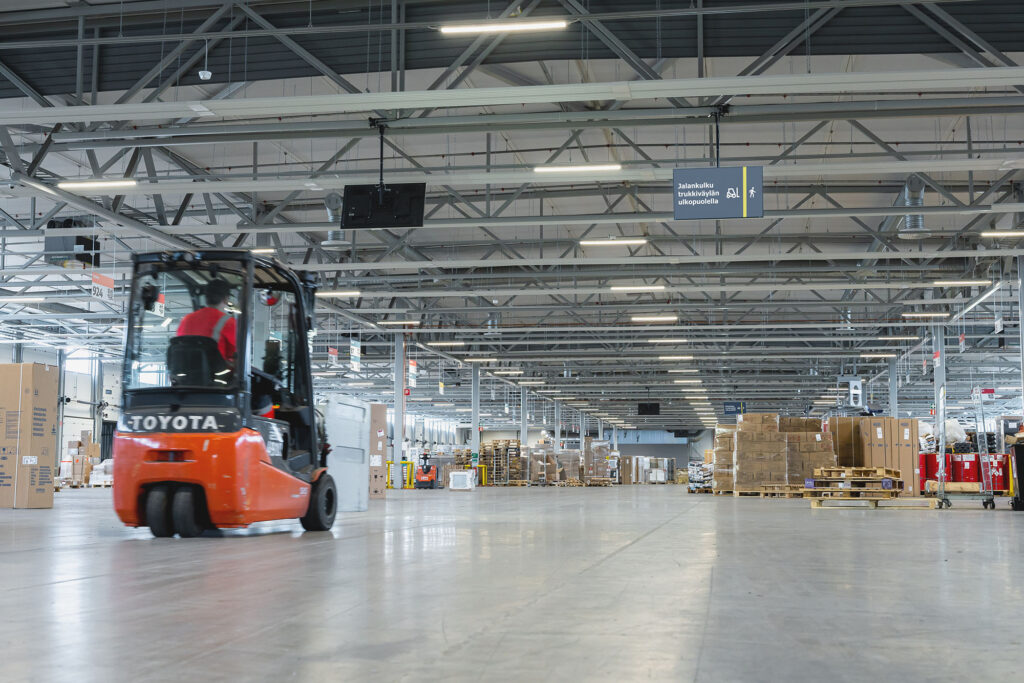
Real-time information about delivery delays, equipment failures or hazardous situations speeds up response times. When information is prominently displayed, it also reduces uncertainty and workload: staff see that the situation is under control and that information is being shared openly.
Digital displays can also be integrated into a warehouse and logistics alarm system. In noisy environments where hearing protection is mandatory, an audible signal is not always enough. Visual alerts and instructions on screens, such as color-coded warnings, evacuation instructions or stop commands, help ensure that the message reaches all employees in an instant.
Read more on the blog about how digital signage improves occupational safety »
Read also: 5 tips for developing company culture and employee experience »
Reducing environmental impact and increasing work efficiency through data and communication
Logistics and warehousing constitute a significant part of many companies’ carbon footprint. Effective inventory monitoring and communication help optimize the speed of goods turnover and reduce unnecessary movement and storage.
By easily displaying up-to-date information on digital screens, such as storage location utilization, aging inventory, picking queues, and transportation fill rates, teams can make better decisions about orders, deliveries, and stock placement. This speeds up warehouse operations, utilizes wasted space more efficiently, and streamlines the flow of goods.
When the circulation of goods is as smooth as possible and the warehouse genuinely serves the flow of the supply chain, the environmental impact of the entire operation is reduced. Digital communication in the warehouse and logistics is therefore not just a “nice to have”, but a concrete tool for achieving sustainability goals.
Key figures visible – manage the supply chain with data
One of the most effective ways to utilize digital displays in logistics is to connect them directly to data. When important warehouse and supply chain metrics are visualized in, for example, Power BI and automatically imported into info displays, reporting becomes part of everyday operations – not just a once-a-month “dashboard session.”
With Power BI integration, you can display information on screens, for example:
- Number of rows collected per hour or shift
- Delivery reliability and OTIF percentage
- Lead times in different processes
- Number of complaints and incorrect deliveries
When these figures are automatically updated from the back-end systems and displayed on info screens in the warehouse, on loading docks or in production rooms, everyone can immediately see how their team is performing and where they are heading. The integration of MediaCloud content management and Power BI allows the same view to be shared across locations, teams and roles without having to manually update reports.
This brings knowledge-based management to a practical level: numbers don’t just live in reports from superiors, but are visible as concrete goals and successes where work is done.
Integrations tie supply chain communications together
Digital displays in warehouses, loading docks and other logistics work environments are only effective when the content is not left to the hands of one person. Remotely controlled displays can bring information from multiple systems and use integrations to build a unified communications entity around the supply chain.
Remotely updated displays can display information from multiple systems and integrate with a variety of software. In addition, announcements can be targeted to different locations, workstations, or via mobile to specific employee groups or teams. Automations enable timely and critical information to be delivered to personnel in real time, without manual work.
In practice, this means, for example:
- Information from the warehouse management system (WMS) about inventory balances and incoming/outgoing deliveries
- Order and production information updated through the enterprise resource planning (ERP) system
- Power BI report visualizations of key metrics
- SharePoint or intranet news related to company-wide internal communications
Read more on the blog: How to recognize an easy-to-use digital signage system? »
How to get started
Carefully designed digital communications can impact supply chain operations in terms of efficiency, safety, costs and environmental impact. When digital displays and data work together, the entire supply chain breathes to the same rhythm.
Would you like some advice on how digital communication could support your warehouse and logistics?
Contact us and let’s think together about what kind of digital signage and integrations would best support your supply chain.