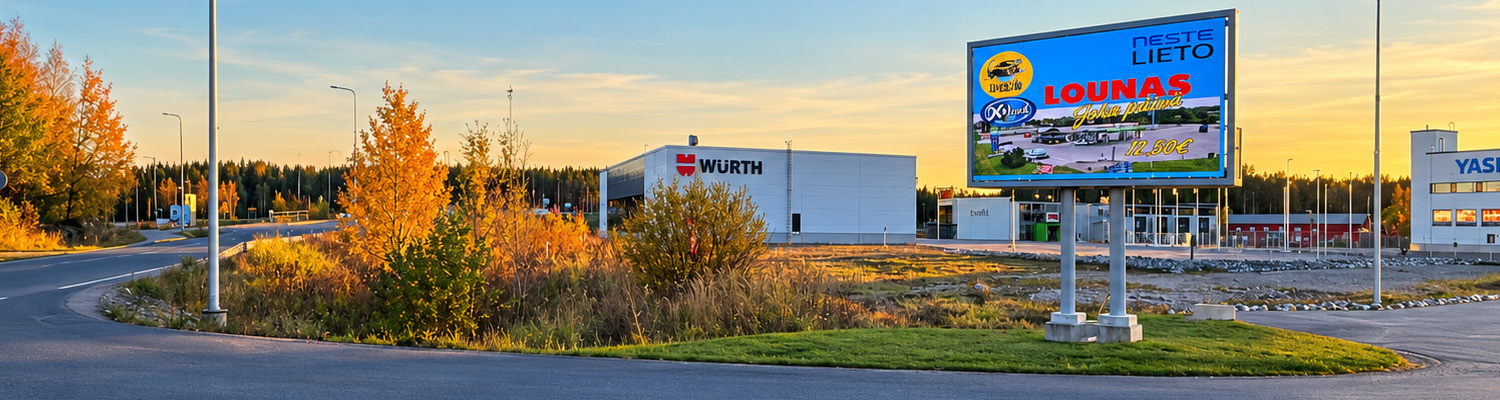
The total cost of an LED display is rarely just the price of the display. Especially outdoors, budget at least a third on top of the hardware price – more for small sites – for the frame and foundations, electrical work, connectivity and permits.
LED screen prices have come down in recent years: the hardware is cheaper, module quality has improved and more displays are being installed in Finland than at the start of the 2020s. At the same time, the rules have changed. The Building Act that came into force at the start of 2025 reformed the permit process.
In this article we go through what the price of an LED display is really made of, how pixel pitch and brightness affect it, which permits you need in Finland and which questions make quotes comparable.
In a nutshell: installed, an LED display costs about €1,600–3,500 per square metre for a typical outdoor display and about €1,900–4,800 for a lobby or retail display (P2.5–P4). Hardware is 60–75 per cent of that; the rest is installation, structures, electrical work and commissioning. A typical outdoor display is 10–20 m², which puts the total investment at about €18,000–51,000. The price per square metre falls as the display gets bigger. Dense fine pitch displays are a class of their own, priced above a standard LED display.
What does an LED screen cost?
Price per square metre is a sensible way to compare LED displays, because a display is always built from modules to the size you need. The prices below are indicative, exclusive of VAT, and based on the general market level.
Hardware without installation or foundations:
| Display type | Pixel pitch | €/m² |
|---|---|---|
| Outdoor display, roadside and facade | P8–P10 | 1,200–1,800 |
| Outdoor display, viewed from closer up | P4–P6 | 1,800–2,800 |
| Indoor display, lobby and retail | P2.5–P4 | 1,500–2,500 |
| Indoor display, close-up viewing | P1.5–P2 | 2,500–4,500 |
| Fine pitch, meeting room and studio | under P1.5 | 4,000–8,000 |
Turnkey delivery: allow a third on top of the hardware price – for small sites under 15 m², up to two thirds. Installation, lift and foundation don’t get much cheaper as the display gets smaller, so the smaller the display, the bigger their share. A wall-mounted indoor display is cheap to install; a free-standing roadside display that needs a foundation, a steel pole, underground cabling and a lift turns the ratio the other way.
A practical example: a 10 m² outdoor display with a P8 pixel pitch typically costs €12,000–18,000 as hardware and €18,000–30,000 installed. The same display at twice the size, 20 m², costs around €32,000–51,000 installed. Not double, because the controller, installation and structure are spread over a larger surface. The price per square metre drops from around €1,800–3,000 to €1,600–2,550.
One thing has clearly changed in recent years: hardware prices have fallen, installation and structural costs haven’t. If you compare a quote with a budget from five years ago, the difference is most likely in the labour, not the display.
What makes up the price of an LED display?
A properly itemised quote should include:
- LED modules. The biggest single item. The price depends on pixel pitch, brightness, IP rating and component quality, among other things.
- Control electronics. Sending card, receiving cards, video processor and controller.
- Mounting or foundation. Anything from a wall bracket to a cast concrete foundation or a steel pole. This is where costs vary the most.
- Electrical work and cabling. Supply cabling and, if needed, changes to the distribution board.
- Connectivity. A fixed line or a 4G/5G modem with a subscription.
- Installation work. Lift, traffic arrangements. Outdoors, the weather affects the schedule too.
- Content management. Software licence or service fee.
- Spare modules. Usually 5–10% of the surface area. Buy them upfront, because production batches can differ.
- Maintenance and support. A recurring cost, not a one-off.
For the buyer, the key distinction is between the one-off investment and running costs. Usually only the one-off investment shows up in the quote. The costs of electricity, content management, connectivity and maintenance keep accumulating for the entire lifetime of the display.
Read also: Digital signage price: What does a digital signage display solution really cost? »
When is an LED display worth it – and when is a standard digital signage display enough?
Start by thinking about what the display is for. What content will it show, where will it be and how far away will people be watching it?
An LED display is the right choice when:
- The display surface is wider than about 2.5 metres. You can’t really get a seamless digital signage display any bigger than that.
- The display goes outdoors. LED clearly wins on brightness and weather resistance, and needs no separate enclosure or cooling.
- The content is viewed from a distance: from the roadside, across a lobby or from the far end of a hall.
- You want a custom size or shape.
- The goal is attention and atmosphere, not reading text.
A standard digital signage display is enough when:
- The display is under 98 inches, about 2.2 metres wide. In this size class, LED isn’t yet competitive on price.
- The content includes a lot of text, lists or timetables read from a few metres away.
- The display goes indoors, where the lighting is under control.
- The budget is fixed and you need many displays.
Read also: Why a basic TV won’t do as a digital signage display »
What is pixel pitch and how does it affect the price?
Pixel pitch tells you how far apart neighbouring pixels are. P10 means ten millimetres. The bigger the P value, the further apart the pixels.
A small pixel pitch gives a denser image that can be viewed from closer up.
With a small pixel pitch, many times more diodes fit on the same surface. That’s why pixel pitch is the single biggest technical choice affecting the price of an LED screen. Size it to the real viewing distance rather than going denser just in case: in the table above, the difference between P10 and P4 is hundreds of euros per square metre.
The relationship between viewing distance and pixel pitch is based on the eye’s resolving power: a person with normal vision can distinguish a detail of about one arcminute. That gives us two useful figures.
- The distance at which the pixels blend together. Multiply the pixel pitch in millimetres by 3,438 and divide by a thousand. For a P10 display: 10 × 3,438 / 1,000 = 34.4 metres.
- Comfortable viewing distance. About half of the above, i.e. the same calculation with a factor of 1,719. This is a rule of thumb, not an exact limit. Content, brightness and whether the viewer is moving all play a part.
| Pixel pitch | Pixels blend together | Comfortable viewing distance |
|---|---|---|
| 1.5 mm | 5.2 m | 2.6 m |
| 2.5 mm | 8.6 m | 4.3 m |
| 4 mm | 13.8 m | 6.9 m |
| 6 mm | 20.6 m | 10.3 m |
| 10 mm | 34.4 m | 17.2 m |
A rule of thumb widely repeated about LED displays says one millimetre of pixel pitch equals one metre of viewing distance. It comes from the American 10× rule, where pixel pitch is multiplied by ten and the result read in feet. Read in metres, the rule leads to roughly double the pixel density – and an unnecessarily expensive display.
The other side of sizing is resolution. Once pixel pitch and size are chosen, resolution follows from them:
- A 6 × 3 m outdoor display with a P10 pixel pitch is 600 × 300 pixels. Enough for the roadside.
- A 3 × 1.7 m lobby display with a P2.5 pixel pitch is 1,200 × 680 pixels.
- Full HD (1,920 × 1,080) at a P2.5 pixel pitch needs a display of at least 4.8 × 2.7 metres.
A standard digital signage display has a fixed resolution, usually Full HD or 4K. On an LED display it is always determined by size and pixel pitch. So check the aspect ratio too: if your content is ready-made 16:9 video, build the display to the same ratio – or take the display’s resolution into account when producing content.
How bright does an LED display need to be?
Brightness is given in nits, i.e. candelas per square metre (cd/m²). Indicative recommendations:
| Location | Recommendation |
|---|---|
| Outdoors, direct sunlight | 4,000–6,500 nits |
| Outdoors, under a canopy or in shade | 2,500–4,000 nits |
| Indoors, lobby or large window area | 1,000–1,500 nits |
| Indoors, normally lit space | 600–1,200 nits |
Brightness alone isn’t enough, though. At least as decisive is how low the display can dim – and the reason is regulation.
Traficom’s regulation on roadside advertising limits the average luminance of an advertising surface during the hours of darkness to a maximum of 300 candelas per square metre, i.e. 300 nits. Cities and regions may also have restrictions of their own. In Helsinki, for example, the night-time limits in commercial centre areas are 200 cd/m² for street-level displays under three square metres, 175 cd/m² for large displays and 150 cd/m² for large advertising surfaces over 20 m². In darker areas the limit must be lower still, and even in daytime the ceiling is 10,000 cd/m². Both Traficom and Helsinki require automatic adjustment: Traficom’s regulation says brightness must change steplessly or in sufficiently fine steps, and Helsinki’s guidance says an outdoor display’s brightness must adjust automatically to the ambient light – and must also be adjustable manually.
In practice this means a 6,000-nit display runs at two to three per cent brightness in the Helsinki night. If the dimming range is coarse or the light sensor poor, the result is either glaring or jumping in steps. Ask the quote for the display’s maximum brightness and its lowest possible brightness level. Also find out whether the adjustment is stepless or stepped, and whether brightness can be adjusted manually when needed.
Dimming also saves energy and can extend the life of the diodes. At night, electricity use is only a fraction of the daytime figure.
What permits does an LED display need in Finland?
Municipal building permit. An illuminated advertising device of at least two square metres – and an LED display is one – requires a building permit everywhere in Finland, and a municipality cannot exempt it through its building ordinance. A smaller display may also need a permit if it has a more than minor effect on the cityscape, landscape, traffic safety or neighbours. Always check the need for a permit with the municipal building control.
Roadside advertising. Outside a local detailed plan area, the advertisement must be notified to the regional Economic Development Centre (elinvoimakeskus) and an approving decision obtained before the display is erected. Within a detailed plan area, the permit comes from the municipality, but the Economic Development Centre is asked for a statement on the location and appearance.
Traficom’s regulation on content. Beside a public road, a changing advertisement must stay the same for at least 30 seconds and must not contain moving images or flashes. The transition between images is done with a fade of about two seconds. In practice: no video on a roadside LED display. If the display is visible from a public road, the 30-second rule applies to advertising your own business too. If the case for the project rests on moving images, move it to a detailed plan area – for example a spot on a building facade that isn’t viewed from the road.
The same regulation also sets distance and visibility requirements for traffic safety: an advertisement may not be placed within 100 metres of another one, and there are stricter limits near junctions, interchanges and traffic control devices. Check suitability before structural design begins.
Additional local conditions. Cities may also have rules of their own. In Helsinki, for example, displays in the immediate vicinity of residential buildings must be switched off between 22:00 and 07:00 and must not be pointed towards homes. The permit application also needs a statement on minimising light nuisance.
Find out before you buy whether permits are included in the quote. Ask whether the supplier handles the permit application and the required visualisations, or whether they are left to you.
How much electricity does an LED display use?
As a guide, an LED display uses 200–500 watts per square metre at peak brightness. Outdoor displays are at the top of the range, indoor displays at the bottom. Average consumption is typically 35–50 per cent of the maximum, because a full-white image at full brightness is practically never shown.
A rough calculation for a 10 m² outdoor display that runs 18 hours a day at the top of the range, about 400–500 W/m²:
- Peak power about 4–5 kW, average about 1.4–2.5 kW
- Annual consumption about 9,000–16,000 kWh
- Annual cost about €900–2,600, when the total price of electricity including transmission and taxes is €0.10–0.16/kWh
Calculate the cost of your own display with your company’s actual total price, because contracts, transmission fees and taxes vary a lot.
Ask for both the maximum power and the estimated average consumption in watts per square metre in the quote. Over a lifetime of ten-plus years, the difference in electricity between two otherwise similar displays can run to thousands of euros.
Read also: Energy-efficient digital signage serves the customer and the environment »
How long does an LED screen last?
Manufacturers often quote a lifetime of up to 100,000 hours. When judging that figure, check whether it refers to L70 or L50. L70 is the point at which 70 per cent of the original brightness remains. At L50, half remains.
So an LED display doesn’t usually die when its lifetime is up – it gradually gets dimmer. The practical replacement point depends on operating hours, brightness level, temperature, maintenance and component quality.
If the manufacturer’s 100,000 hours refers to L50, it works out to the following calendar times at different daily usage:
| Hours per day | 100,000 hours in calendar years |
|---|---|
| 12 h/day | about 23 years |
| 18 h/day | about 15 years |
| 24/7 | about 11 years |
The practical replacement point depends on operating hours, brightness, temperature and component quality. Automatic dimming extends the lifetime significantly. For comparison, the panel of a commercial LCD digital signage display is typically rated at 50,000–70,000 hours – clearly shorter-lived.
Warranty is a different thing from lifetime. In our experience, manufacturers’ warranties range from two to eight years, but the most common is 3–5 years. Before buying, confirm the warranty period for the specific product and whether it also covers labour.
Modularity is a major advantage of LED screens: a single damaged module is replaced, not the whole display. It’s a good idea to stock spare modules for about 5–10% of the surface area when you buy the display.
Where can an LED screen be installed?
An LED display is typically installed on a wall, a facade, a free-standing frame or a pole. The installation site has a significant effect on the total price. Thanks to its modular structure, LED also fits places where a standard display won’t go. The surface can be built curved, very wide and low, or wrapped around a doorway, a lift or a pillar.
Things to find out when choosing the installation site:
- Load-bearing capacity. The wall, roof or foundation must bear the display’s weight and the wind load. Outdoors, wind load is often the deciding factor, not the weight of the display.
- Service access. Can a module be replaced from the front, or do you need access behind the display? A front-serviceable display is usually more expensive to buy and cheaper to maintain.
- Sightlines and viewing distance. The further away the display is viewed from, the bigger it needs to be.
The most common sizing mistake is a display that’s too small. A sixteen-square-metre display looks huge on the wall of a hall and rather small on a pole beside a main road. So go and look at a display of the same size on site before you decide. Drive past it at the same speed your target audience will pass the planned location.


How to compare LED display quotes
The price of an LED display only becomes comparable once the quotes cover the same things:
- Pixel pitch in relation to the real viewing distance. Ask for the reasoning, not just a recommendation.
- Brightness and dimming range. Maximum, minimum, how finely the adjustment is stepped and whether brightness can also be adjusted manually.
- IP rating for the front and back separately. For outdoor displays the established level is IP65 at the front and IP54 at the back. Newer models increasingly have IP66 for the whole cabinet. IP65 withstands rain and low-pressure water jets.
- Operating temperature range and condensation control. Ask for the temperature range in degrees. The IP rating says nothing about frost resistance.
- Warranty in years, and what it covers. Modules, power supplies, control electronics and labour.
- Availability of spare parts. For how many years modules will be available, and whether spare modules are priced into the quote.
- What the installation price includes. Steel structure, foundation, lift, electrical work, connectivity, traffic arrangements, commissioning.
- Content management. Licence price, number of users, whether content is made in-house or as a service, and whether the same system is used on your other displays.
- Maintenance agreement. Monthly price, response time, and whether it covers module replacements or only remote support.
- Power consumption. Both maximum and estimated average, W/m².
- Permits. Who applies for the building permit and files the notification with the Economic Development Centre, and whether visualisations are included in the delivery.
- CE marking and conformity. Ask for the declaration of conformity too, not just the CE mark.
Frequently asked questions
Installed, about €1,600–3,500/m² for a typical outdoor display and about €1,900–4,800/m² for a lobby or retail display. On top of the hardware price, allow about a third for installation, structures and electrical work. The price per square metre falls as the display gets bigger, so a 20 m² display is cheaper per square metre than a 10 m² one.
For a roadside display viewed from 20–40 metres, P8–P10 is enough. For a facade display viewed from 10–20 metres, P4–P6 is suitable. Calculate the comfortable viewing distance by multiplying the pixel pitch in millimetres by 1,719. Divide the result by a thousand to get metres.
An illuminated advertising device of at least two square metres requires a building permit. A smaller LED display may also need one if it has a more than minor effect on the cityscape, landscape, traffic safety or neighbours. Check the need for a permit with the municipal building control.
No. Traficom’s regulation requires that changing content stays the same for at least 30 seconds and contains no moving images or flashes. The rule doesn’t care who owns the plot: if the display is visible from a public road, it applies to advertising your own business too.
200–500 W/m² at peak brightness, on average 35–50 per cent of that. A 10 m² outdoor display running 18 hours a day uses about 9,000–16,000 kWh a year.
Under 98 inches and indoors, a standard digital signage display is clearly cheaper. LED is worth it when the display surface is over 2.5 metres wide, the display goes outdoors, the content is viewed from a distance or you want a custom shape.
The modules’ nominal 100,000 hours refers to the point at which brightness has halved (L50). A realistic lifetime at 18 hours a day is 12–18 years. The warranty is typically 3–5 years.
Yes, and it’s worth doing. In MediaCloud, the LED display, lobby signage and meeting room door displays are all in one view. You can also easily give content producers or advertising partners access to the LED display alone.
Ask for a cost estimate for your site
Tell us the planned location, estimated size and viewing distance of the display. With these, you’ll get an indicative cost estimate and our view on a suitable pixel pitch, brightness and the structures required.
Ask for an LED display cost estimate »
If you’re still exploring your options, start with our digital signage solutions.