A great in-store experience rarely comes down to one thing. Can customers easily find what they’re looking for? Do they have to guess whose turn it is? Does the space look and feel like your brand? The in-store customer journey is made up of exactly these small moments: the greeting, the soundscape, the content on the screens and how smoothly everything runs. When you design them deliberately, the store becomes part of the customer experience – not just a place where things are bought.
The physical store gives you excellent tools for this: visual and audio elements, plus wayfinding and communication that look like your brand. This post looks at what the in-store customer journey looks like in practice and how you can improve it with a soundscape, digital signage and queue management.
Designing the customer journey starts from the customer’s point of view
In a store, customers are constantly making small observations and choices: where to go in, where to find the right product or service, whether they need to queue and what happens next. At the same time, the space is shaping their image of your brand through its visual look, its sound and how smooth the visit feels.
That’s why the key to designing the customer journey is to look at the store through the customer’s eyes. Where do they need guidance? Where does uncertainty or unnecessary waiting creep in? And where could you inspire them, make the buying decision easier or strengthen the brand experience?
You can influence these moments with, for example, a soundscape, information and advertising screens, and by designing how queuing and service situations work. The tools vary along the journey – the entrance needs different things than the service desk or the waiting area.
What does the in-store customer journey look like in practice?
| Stage of the journey | What the customer needs | How the store environment helps |
|---|---|---|
| Entrance | To understand where they are and what’s going on | Window displays, welcome content, soundscape |
| Moving around the store | An easy way to find products and services | Wayfinding, digital signage, product content |
| Getting to the service | To know where to go and what to do | Wayfinding, queue management system |
| Waiting | To know where they stand and something meaningful to do while waiting | Queue display, instructions, timely content |
| Buying decision | Enough information to support the decision | Product and service content |
| Leaving the store | A clear next step | Loyalty programme, feedback, additional services |
A soundscape sets the right mood
A soundscape starts working before the customer consciously notices it. Studies have found a link between background music that fits the brand, a better customer experience and buying behaviour. The soundscape creates the atmosphere a customer meets when they walk in. Does that atmosphere match what they expect from your brand?
Choose a soundscape that fits your brand and the kind of visit you want to create. If you want things to move quickly and dynamically, upbeat and energetic music can nudge the customer’s mood in the right direction. In a take-away café, for example, a brisk, no-fuss atmosphere supports quick service.
If your products call for more consideration, a calm soundscape supports an unhurried visit and a longer stay in the store. In a specialist clothing shop, for instance, trying things on and thinking them over in peace can be an important part of the journey. You may also want to encourage customers to ask for expert advice and simply enjoy the space.
It’s also worth updating the soundscape over time: a calmer morning mood can give way to a livelier afternoon playlist, and a season or campaign can be heard in the music too – not just seen on the screens.
Building the right soundscape doesn’t take a studio or a music producer. Licence-free background music and ready-made playlists curated to your brand are enough for most stores – with no separate Teosto or Gramex fees.
Dig deeper in our post: A soundscape builds your brand and gives you an edge »
Digital signage guides customers and strengthens your visual identity
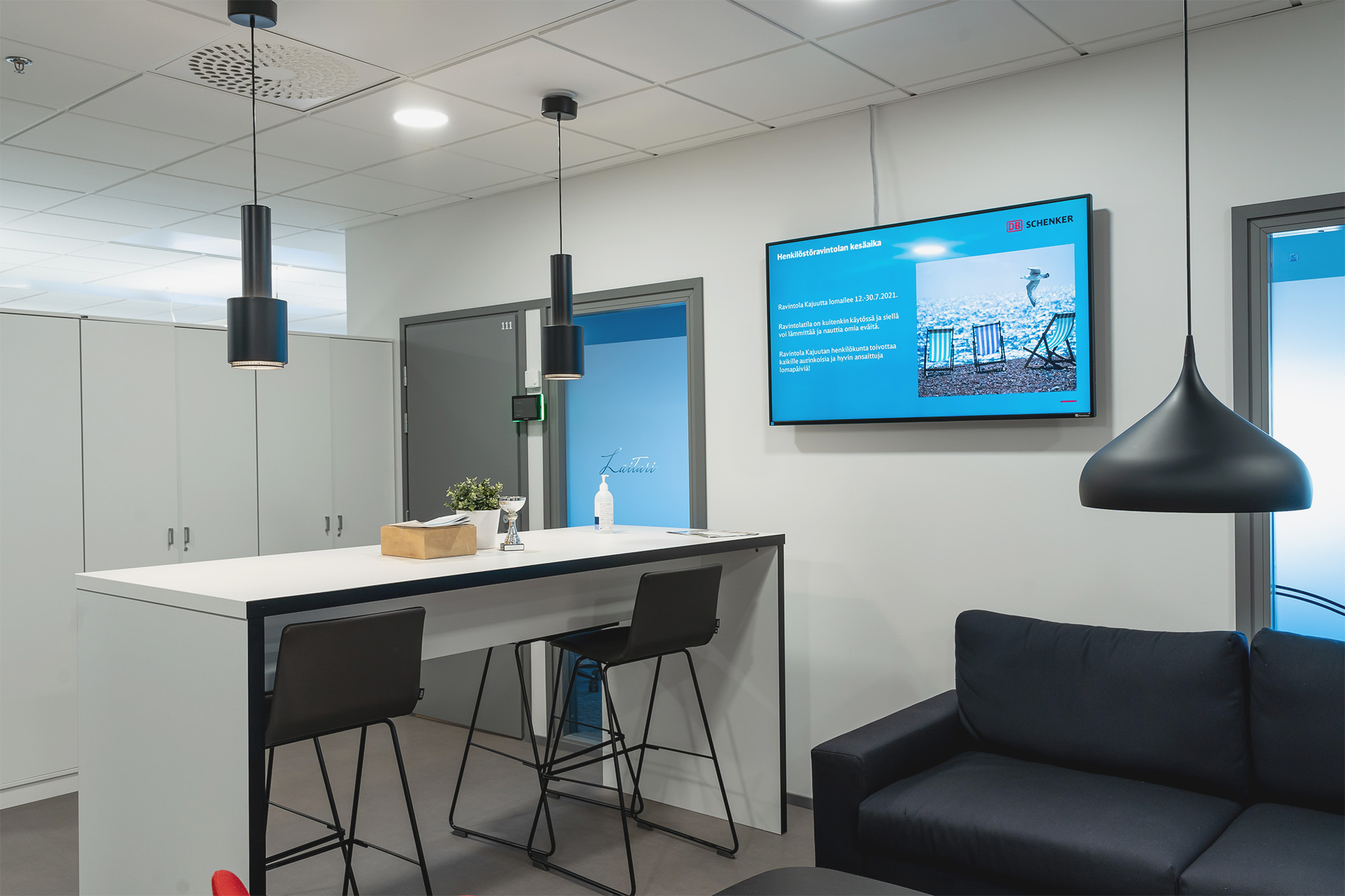
Information and advertising screens help customers find their way around the store and locate the products, service and advice they’re looking for. If the in-store journey has many stages, digital signage is a good way to guide customers in your brand’s own tone of voice and visual style.
At an optician’s, for example, the journey may involve trying on frames, queuing to see a specialist and then being served first by the optician and then by a sales assistant – clear on-screen communication supports a multi-stage visit like this.
Digital signage also supports your brand’s visual identity. A recognisable look meets the customer already in the shop window and is repeated inside the store.
A screen can rotate between a product presentation, a current campaign, service instructions and your brand’s own story. The right mix depends on where along the journey the screen sits. Unlike static elements such as stands and posters, digital screens let the content in your store change with campaigns, seasons or even the time of day.
The same content doesn’t belong on every screen, though: at the entrance the job is to spark interest, near the service desk to guide action, and in the queuing area to make waiting easier. Where a screen sits along the journey determines what kind of content works best on it.
When the screens are managed centrally with MediaCloud content management, content can be targeted not only by store but also by the screen’s role, the time of day and the campaign.
Read also: How does the placement of a digital sign affect how well it communicates? »
Queue management as part of the customer journey
Queuing can be one of a store’s pain points: long waits or an unclear order of service easily stir up negative feelings. Studies have found that an unclear waiting situation can sour the experience even when the wait itself isn’t long. And a worse experience, in turn, affects buying decisions and recommendations.
A well-designed queue management system doesn’t just show the queue status clearly – it also steers the customer’s attention to the right content and information while they wait. A screen can, for example, tell customers how to prepare for the service situation or what the assistant will most likely ask first.
When a buying decision calls for expert help, waiting can be an essential part of the visit. That’s when a clear queue, information about the waiting time and the chance to put that time to good use matter most.
The FirstQueue queue management system combines a clear queue display with digital signage content management, so the waiting time becomes part of a designed customer journey instead of a disconnected gap.
Dig deeper: Smart queue management in a service store »
Read also: Digital signage in the waiting area »
Frequently asked questions
The in-store customer journey describes how a customer moves from the moment a need arises to visiting the store, making a buying decision and possibly staying in touch afterwards. The journey is made up of stages, goals and touchpoints: the customer looks for information, arrives at the store, moves around, explores products or services, asks for help, waits, makes decisions and finally leaves. Designing the journey means looking at how smoothly these stages flow and what kind of experience they create together.
The soundscape creates the atmosphere a customer meets the moment they walk in. A soundscape that fits the brand strengthens the image of your company and can steer customer behaviour – for example, how quickly they make buying decisions.
Digital signage helps customers find their way around, highlights products and offers, and strengthens your brand’s visual identity from the shop window onwards. The content can be managed centrally for all your stores.
Yes. A soundscape and digital signage benefit smaller stores too, because both affect the customer experience regardless of the size of the shop. A queue management system pays off especially when the store has several service points or clear peak hours.
Start by mapping the customer’s journey from the entrance to the exit and identify the points where the visit slows down, causes uncertainty or demands unnecessary effort. What does the customer see, hear and experience from stepping in to reaching the checkout? Then pick one area at a time – say, the soundscape or digital signage – and assess whether it supports the customer experience and brand you want. This also makes it easier to judge the impact of each change, since you’re not changing everything at once.
Not necessarily. A chain’s customer experience should be recognisable, but every store doesn’t have to be identical. Central management makes a shared brand look and nationwide content possible, while campaigns, services, opening hours and queue messaging can be adapted store by store.
At its best, you don’t notice a designed customer journey
A good in-store customer journey doesn’t mean cramming the store with as much technology as possible. A screen, music or a queue management system only has value when it takes one question off the customer’s mind, makes a choice easier or makes the visit a little more pleasant.
For chains, this means a consistent brand look and soundscape in every location, even if campaigns and services vary from store to store.
At its best, the customer doesn’t even notice that the whole thing has been designed. They easily find the right place, know what happens next and feel that everything just works.
Are there still points in your store’s customer journey where customers have to guess, wait or search? Explore our display solutions or book a free demo with our experts.
Read also: Marketing while customers wait brings extra sales »
Sources: Markkinointiuutiset – a study on the effect of background music on the customer experience | Pruyn, A. & Smidts, A. (1998). Effects of waiting on the satisfaction with the service: Beyond objective time measures. International Journal of Research in Marketing 15(4), 321–334.