A customer waiting in line has already made one important decision: they have come to you. That makes the moment spent queuing unusually interesting from a marketing point of view. The customer follows the queue status to see when their turn arrives, so the screen already has a natural reason to hold their attention. Marketing during the wait means using this moment wisely – alongside the queue number you can show useful instructions, timely services, campaigns and products that support both the customer experience and additional sales.
This blog post takes a closer look at why queue time is worth putting to work for marketing, what is worth communicating to a waiting customer, and how the whole thing is built in practice by combining an intelligent queue management system with information displays.
A customer waiting in line is already well along the purchase path
A customer in the queue is no longer just getting to know your company or considering whether to visit. They have already come in, taken a queue number and are waiting to be served. From a marketing point of view the moment is an interesting one, because the customer is already close to the service situation – and often close to their next purchase decision as well.
The waiting time is a chance to highlight products and services that complement the customer’s original need. In a pharmacy it may be a timely self-care product, in a service store an accessory, and at a health centre a service the customer did not yet know about. Good content does not try to invent a new need out of thin air; it helps the customer notice something that suits the situation.
A queue display has a special advantage here: the customer already has a reason to keep looking at it. They follow how the queue is progressing and check when their own turn is coming up. At the same time, the other content on the screen gets the chance to be seen as a natural part of the visit.
Empty waiting feels longer than it really is
One thing is known for certain about the psychology of queuing: idle time feels longer when there is nothing to do. Studies have found that waiting time in which people have something to watch or do is experienced as clearly shorter than the same time without any stimulus – and not knowing how long the wait will last stretches the experience even further.
This is an essential observation for marketing. When the screen shows interesting content alongside the queue status, two things happen at once: the customer’s experience of waiting improves and your message gets seen. Content is therefore not competing with a good service experience – it is part of it.
This is also why marketing and communication during the wait works well and is not experienced as intrusive. A waiting customer follows the queue status on the information display anyway, so their attention has already been won. Nobody joins a queue to watch adverts, but when their eyes are on the screen in any case, a timely offer or service tip is welcome.
Clear queue information can also reduce the uncertainty that makes waiting feel longer. When the customer knows where the queue stands and what happens while they wait, the visit feels more under control. That can also help to reduce the temptation to give up halfway through the wait.
According to research 74 percent of customers noticed the digital POS screens in the store. Four out of the five brands included in the study increased their sales during the screen advertising period, by as much as 33 percent . In a queuing situation the starting point is even more favourable, because the audience is not passing by but standing still in front of the screen.
Lue lisää aiheesta, miten jonotusjärjestelmä parantaa asiakastyytyväisyyttä? »
Mitä jonottavalle asiakkaalle kannattaa viestiä?
An effective content rotation could be built from these three layers, for example:
- The most important information is always the queue status: which number is being served and how much of the wait is left. When this is clearly visible, the customer relaxes and is receptive to all the other messages.
- Share useful information: service instructions, opening hours and how to prepare for the appointment. If the customer can take care of part of their business while still in the queue, the service itself is faster and the whole queue moves more smoothly.
- Upselling and marketing: current offers, seasonal products and services the customer did not know about. When the first two layers are in place, the third one irritates nobody.
In practice this means a content rotation in which the queue status is always visible and the other content changes alongside it at a suitable rhythm. As a rule of thumb, roughly this division works: the bulk of the rotation for useful information and service communication, the sharpest edge for sales. The balance can also shift with the season: in December campaigns are given more room than in February.
The length of the content should be matched to the length of the wait. In a short queue, one quickly digestible highlight gets through: one product, one price, one message. In a wait of a few minutes there is already room on the screen for product presentations, complementary services or usage tips. In a longer wait you can say more about services, loyalty programmes or upcoming events.
The ticket number and queue information should always be kept easy to spot and treated as the primary content. The screen’s most important job is to be a queue display, and only after that an advertising display. If the customer has to hunt for their own turn behind a campaign video, the whole idea backfires.
What does this look like in a store, a pharmacy, a grocery shop and a health centre?
In practice, marketing during the wait looks different in different service settings, but the same three-layer logic adapts to them all. Four examples from everyday life:
Service store: add-on products while waiting in line
When selling add-on products, the moment of waiting is especially effective, because the content can carry on from where the customer’s original purchase leaves off. Someone looking for a laptop is worth reminding about a dock, a mouse or headphones – things they will need anyway but did not think of. The same applies to highlights at the spare parts desk and for maintenance services: while the customer waits their turn, they have time to consider new purchases.
Read also the blog: Smart queuing system in a service-point store »
Private health centre: trust and additional services
A customer sitting in the reception lobby values clarity above all: when is my turn and where do I need to go. Once that is taken care of, the screens can tell people about services that often go unnoticed – extensions to occupational health care, vaccination campaigns and specialist appointments. At a health centre, communication during the wait is not only upselling; it is also a way to build the image of a service that is up to date and that cares.
Ticket number and ad campaign on the same screen: here is how it works
Grocery store and restaurant: the deal of the day at the right moment
In practice, the whole is built from two parts that work together: the queue management system and the information displays.
Private health centre: trust and additional services
Waiting-room customers in reception areas value clarity above all: when is my turn, and where do I need to go. Once that’s covered, screens can highlight services that often go unnoticed — occupational healthcare expansions, vaccination campaigns, and specialist appointments. At a health center, communicating during the wait isn’t just about upselling — it’s also a way to build the image of a service that’s up to date and cares.
Queue numbers and ad campaigns on the same screen: how it works
In practice, the whole setup is built from two parts that work together: the queuing system and the digital signage.
FirstQueue handles ticket numbers, mobile queuing, calls, and queue status views. The smart queue management system operates as part of FirstView’s digital signage system. On the same screen, marketing content runs alongside the queue status — content you can manage in the same service as all your other displays.
For a chain, this means the same content loop can be rolled out to every location with a single click — while an individual location can still add its own local highlights. There’s no need for separate content systems for different screens: the content for queue displays and other digital signage stays within the same overall system.
Mobile queuing extends the possibilities even further. When a customer joins the queue via a QR code, they don’t have to stand in front of the screen — they can move freely around the store and browse products and campaigns while they wait. This way, the queuing system doesn’t tie the customer to a waiting area, but can guide them to spend their waiting time elsewhere in the space.
Updating marketing content is easy, for example, with MediaCloud’s Canva integration. You can design campaigns and other display content in the Canva you already know and bring it straight to your digital signage. That way, a daily offer, a seasonal product, or a new service can be swapped in quickly whenever the content is timely.
Read more: Smoother content creation with Canva »
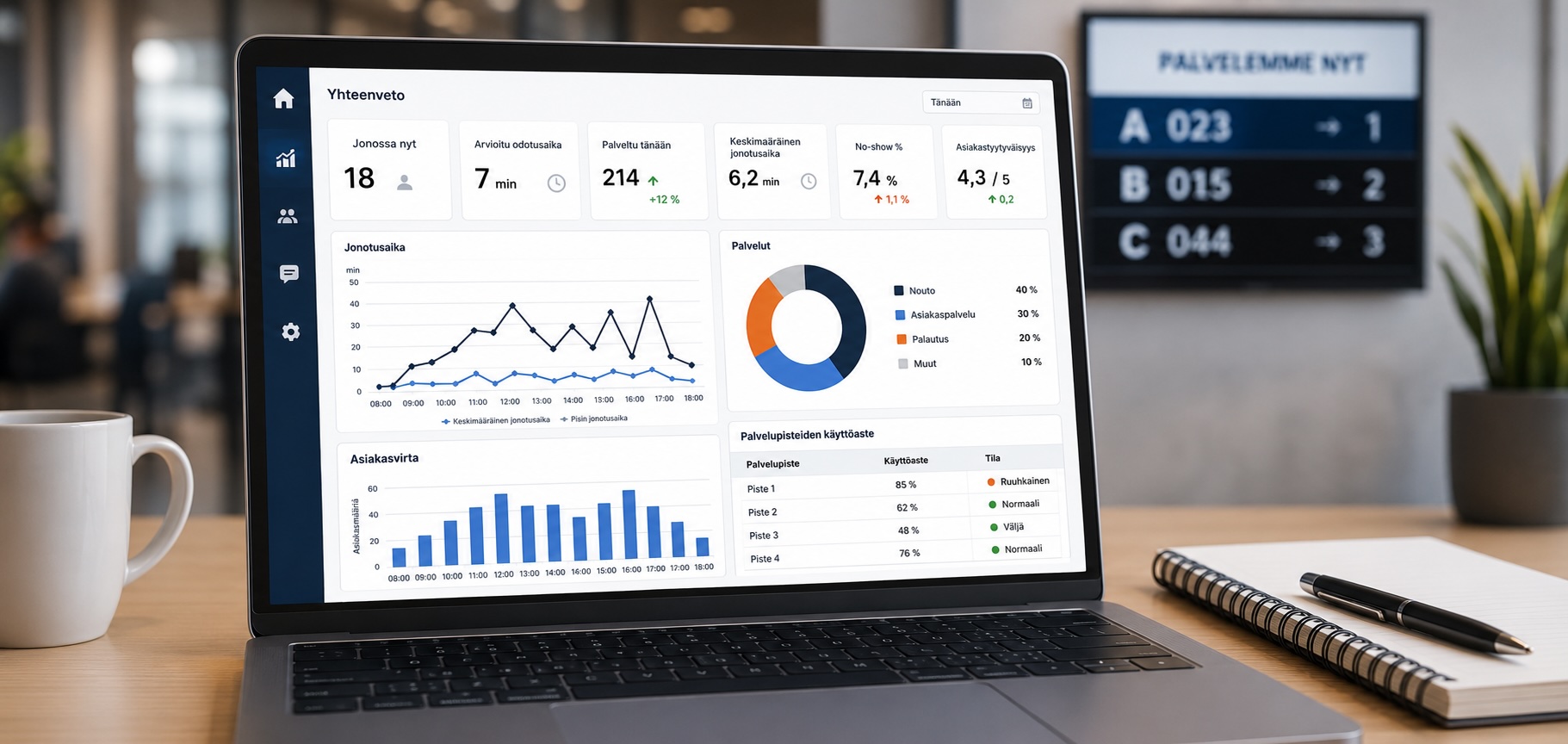
Queue data helps you plan better content
The queuing system collects information about customer numbers, peak times, and average waiting times, for example. This tells marketing something very concrete: when the screens are most crowded and how much time customers have to watch the content.
If the average wait during rush hour lasts several minutes, the content loop can showcase services, products, or current campaigns in a bit more depth. In a fast-moving queue, on the other hand, the message needs to land within a few seconds. One offer, one product, or one clear call to action works better than a long content loop the customer only catches the start of.
Queue data also helps identify the times when a marketing message reaches the largest potential audience. If a particular service point repeatedly gets busy in the afternoons or on weekends, for example, those are exactly the moments to plan content and campaigns suited to the situation.
Looking at queue data alongside sales data also makes it possible to assess whether campaigns or specific time periods show up in sales too. The systems don’t need to be technically connected — simply comparing figures for the same location and time period can help uncover interesting patterns and plan the next campaign more effectively.
Read more about what data you can get from the queuing system and how to use it »
How do you know if your queue-screen marketing is working?
The success of queue-screen marketing is worth evaluating the same way as any other campaign: what happened before, during, and after the campaign? If you feature a particular product or service on screen, track how its sales develop at the same time. An even better comparison comes from running the campaign at only some locations, or for a specific period only.
You can also add a measurable call to action to the screen, such as a campaign-specific QR code, a discount, or a promo code. That gives a more direct view of how many people responded to that particular piece of content. Queue system data rounds out the picture by showing how many customers were present and how long they waited on average — in other words, how large the campaign’s potential audience actually was.
That said, it’s best not to draw far-reaching conclusions from a single sales spike. Sales are affected at the same time by seasonality, pricing, other marketing, and many other factors. But comparing results across different time periods, locations, and campaigns starts to reveal which types of content work best specifically during the wait. The goal isn’t perfect attribution — it’s making the next campaign smarter than the last.
Frequently asked questions about queue-time marketing
It can, if it’s the only content shown. When the queue status and other useful information take priority, and campaigns are paced in between, the content is experienced more as a service.
Yes — and that’s the whole point. FirstView’s queuing system and digital signage run on the same content management platform, so queue status and marketing content play on the same screens without separate devices or two different systems.
Within minutes. Updating content is quick and easy.
Even a few minutes’ wait is enough. If the queue moves in under a minute, focus instead on clarity of the queue status, and perhaps one easy-to-grasp piece of marketing content. The best environments are pharmacies, service retail stores, grocery store service counters, and private health centers.
Turn waiting time into a moment that sells
Queuing can’t be eliminated entirely from any service space. But it can be turned into a moment that benefits both sides: the customer gets reassurance and useful information, and you get the attention of an engaged audience. At its best, marketing during the wait doesn’t look like marketing at all — the customer is simply left with the feeling that the visit was easy and that they got something out of it.
What would this look like in your own space? Book a free demo with our experts, and let’s look together at what your queue could be telling your customers.
Read more on this topic: Digital signage in waiting areas – more than just a ticket number display »
Sources
- Maister, D. H. (1985). The Psychology of Waiting Lines. In Czepiel, J. A., Solomon, M. R. & Surprenant, C. F. (Eds.), The Service Encounter. Lexington Books.
- Nielsen & EDEKA, in-store study on the attention value of digital displays.